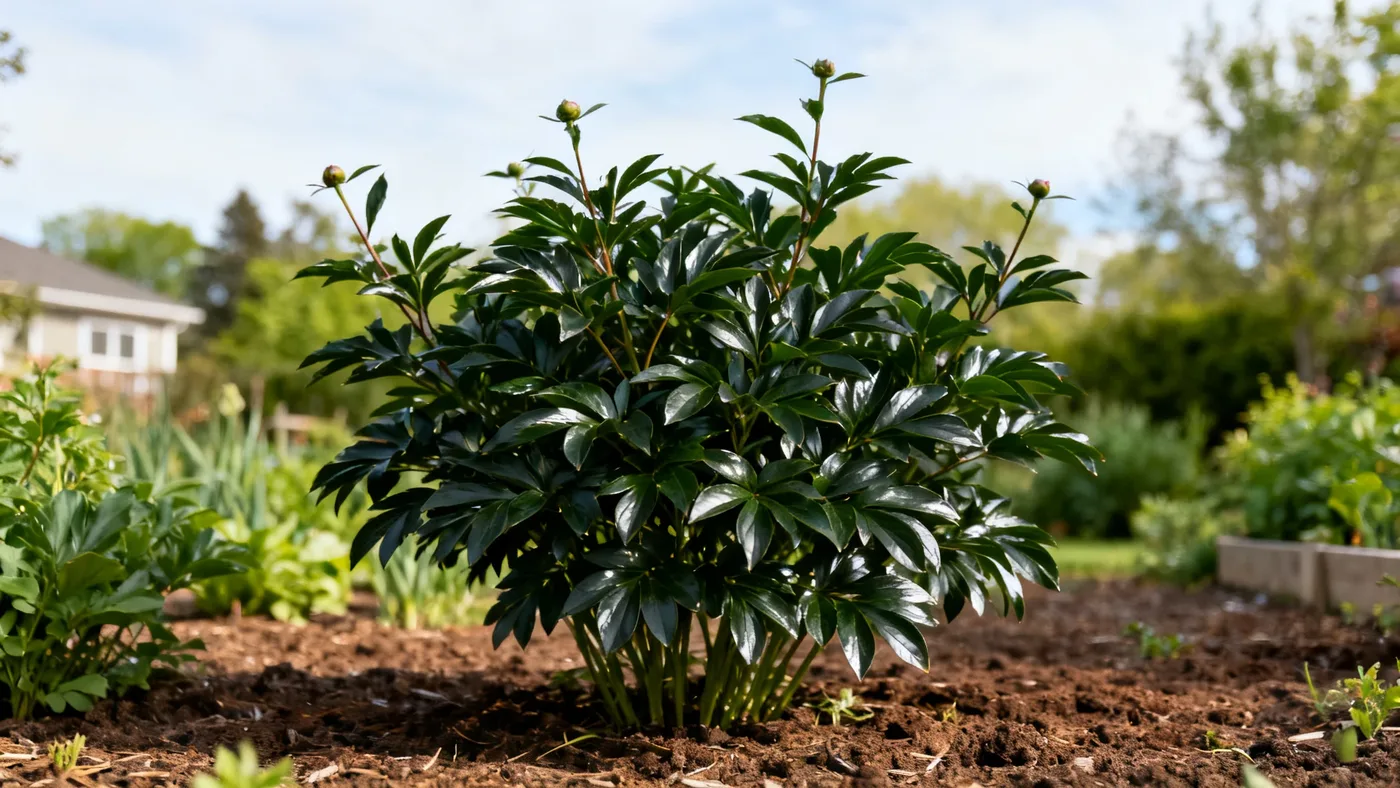
Kansas Peony Sun Requirements: Full Sun vs Partial Shade
Kansas Peony is a sun-loving plant, and light exposure directly affects how many blooms you get each spring. Unlike some perennials that tolerate shade gracefully, this red double-flowered peony performs best under direct sunlight. Understanding your garden's light patterns and choosing the right planting spot is the foundation of a thriving peony bed.
Understanding Kansas Peony Sun Requirements
Kansas Peony requires a minimum of 6 or more hours of direct sunlight each day to flower well. This is a hard threshold, not a rough guideline. When the plant receives less light than this, flowering declines noticeably and stem strength suffers, making plants prone to flopping under the weight of their own buds.
In hot southern regions (USDA zones 6 to 8), Kansas Peony can tolerate light afternoon shade, particularly in late afternoon when temperatures peak. However, even in these zones, morning sun is non-negotiable. Afternoon shade simply takes the edge off extreme heat; it does not replace the 6-hour full-sun requirement.
Red-flowered peonies like Kansas are naturally somewhat less robust than pink or white cultivars, making sunlight even more critical to their performance. A plant that receives only 4 hours of sun may produce scattered buds instead of the full display you expect. A plant in 3 hours or less will likely fail to flower in its first years and may never reach its potential.
Step 1: Map Your Garden's Light Patterns
Before choosing a planting spot, spend at least one full week observing how sunlight moves across your yard. This step is essential because sun patterns change with the season, and what feels like full sun in April may be half-shaded by July as trees leaf out.
What you need:
- A simple watch or phone with time function
- Paper or a notes app to record observations
- A clear view of your garden from mid-morning through late afternoon
Observe over 7 days:
- At 9 a.m., mark which areas receive direct sun. Take a photo or sketch your yard, noting shadows cast by buildings, trees, and fences.
- Repeat at noon, 3 p.m., and 6 p.m. on at least three different days (ideally one clear, one partly cloudy, one fully cloudy).
- Count the total hours of direct sunlight each potential planting area receives. Full sun means no shade from trees, structures, or other plants during those hours.
- Note which trees are deciduous (losing leaves in winter) and which are evergreen. Deciduous trees will shade less in early spring when your peony blooms, but heavily in summer.
Use this data to identify spots that receive 6 or more uninterrupted hours of direct sun. If you cannot find a 6-hour spot, focus on morning sun; afternoon sun is secondary. A bed that receives sun from 7 a.m. to 2 p.m. is preferable to one that gets sun from 11 a.m. to 5 p.m., especially if afternoon sun brings heat stress.
Step 2: Evaluate Soil and Drainage at Your Chosen Spot
Sun exposure is only half the equation. Kansas Peony also requires fertile, humus-rich, well-drained soil with a pH between 6.5 and 7.0 (slightly acidic to neutral). A location with perfect light but waterlogged soil will fail.
Perform a simple drainage test:
- Dig a hole 12 inches deep and 12 inches wide at your chosen planting spot.
- Fill the hole with water and let it drain completely.
- Fill it again and time how long the water takes to drain. Good drainage means the hole empties within 1 to 2 hours. If water remains after 3 to 4 hours, the soil retains moisture too long for peonies.
- If drainage is poor, amend the area with 2 to 3 inches of compost worked into the top 8 to 10 inches of soil to improve water movement and organic matter.
Check the soil texture by hand. Squeeze moist soil from the planting area. If it forms a tight ball that does not crumble easily, it is clay-heavy and needs organic matter. If it falls apart immediately, it may be sandy and need compost to hold nutrients and moisture.
Step 3: Plan for Mature Plant Size and Air Circulation
Kansas Peony grows 24 to 30 inches tall and spreads 24 to 36 inches wide at maturity. More importantly, it reaches full size over 3 to 4 years, gaining 6 to 12 inches of spread per year while establishing. Plant at least 3 feet (30 to 36 inches) apart from other plants to ensure good air circulation, which helps prevent disease.
Steps to finalize your location:
- Measure out a 3-foot circle around your chosen planting spot.
- Confirm that no other plants, structures, or features will shade this area as the peony matures.
- Verify that neighboring plants are far enough away that they will not compete for water or nutrients. Peonies are long-lived and do not like being moved, so this is your only chance to get spacing right.
- For locations near buildings or walls that absorb and radiate heat, note this detail. In zones 6 to 8, this extra heat may be beneficial, but in zones 3 to 5, it is neutral.
Step 4: Monitor Your Plant's Response in Year One and Beyond
Even with good light, new peonies take time to establish. A first-year plant may produce only a few buds; a second-year plant may flower lightly. By year 3 to 4, the plant should reach flowering maturity.
Track these indicators:
- Record bloom date each spring (typically May, though timing shifts 2 to 4 weeks depending on your zone and region).
- Count the number of flower buds that form. Increasing bud count over years signals the plant is thriving.
- Observe stem strength. Drooping stems despite staking, or buds that fail to open, suggest insufficient light or humidity issues (botrytis blight).
- If blooms decline after the first year or two, your spot may have inadequate light. Consider whether tree growth has changed the shade pattern.
If your peony underperforms, check the sun exposure again. If nearby trees have grown denser or a building shade has shifted, the plant may no longer receive the 6+ hours it needs. In this case, your only remedy is relocation (fall is best), as Kansas Peony will not rebound on its own in insufficient light.
Zone-Specific Sun Considerations
Your USDA hardiness zone influences how much afternoon shade is tolerable.
Zones 3 to 5 (cool regions): Aim for 6+ hours of full sun throughout the day. These zones do not get extreme afternoon heat, so afternoon shade provides no benefit. Morning and midday sun is ideal.
Zones 6 to 8 (warmer to hot regions): Full sun (6+ hours) is still required, but light afternoon shade in summer can reduce heat stress. This means 6 hours in morning to early afternoon, with optional dappled shade after 4 p.m. However, this shade must not encroach on the 6-hour minimum.
Common Mistakes to Avoid
Planting under trees for "part shade". Deciduous trees that shade heavily in summer often create dry, root-choked conditions by the time your peony blooms in late spring. The shade is welcome, but the competition for water and nutrients is not. If you must plant near a tree, choose a spot where the tree will not shade the peony until after bloom time (typically late May onward in most zones).
Trusting visual sunlight without measuring time. An area that looks sunny at 10 a.m. may receive only 4 hours of direct light if shade returns by 2 p.m. Use a clock to verify, not your eye.
Overcompensating with afternoon shade in cool zones. In zones 3 to 5, there is no heat stress to mitigate. Any shade you provide is lost flowering time. Maximize sun in these regions.
Ignoring drainage in exchange for sun. A south-facing slope with perfect light but clay drainage is worse than a mostly sunny spot with amended, draining soil. Peonies can tolerate partial shade better than waterlogged roots.
Assuming the first year's performance is final. Kansas Peony improves significantly over its first 3 to 4 years. A light first bloom is normal, not a sign that your location is wrong.
Expected Results and Timeline
A Kansas Peony planted in an optimal location (6+ hours of full sun, well-drained soil) will produce a noticeable increase in flower buds each year for the first 3 to 4 years. By year four, the plant should reach its mature flowering potential, typically producing multiple stems heavy with deep red, double flowers in late spring.
In locations with 4 to 6 hours of light, flowering may occur but will be reduced and stems may require support. In locations with less than 4 hours of direct sun, blooming is unlikely in the early years and may never develop fully. For more complete information on planting and ongoing care, see the Kansas Peony care guide.
Quick Reference: Sun Requirements Checklist
| Factor | Requirement | Impact if Not Met |
|---|---|---|
| Direct sunlight per day | 6+ hours minimum | Fewer buds, weak stems, poor flowering |
| Sunlight timing | Prioritize morning and midday | Afternoon-only sun still counts but less reliable in zones 3-5 |
| Afternoon shade (zones 6-8) | Optional, light shade after 4 p.m. only | Excessive shade cancels benefits |
| Afternoon shade (zones 3-5) | Not needed; full sun preferred | Reduces blooming without heat benefit |
| Spacing from neighbors | 3 feet minimum distance | Competition for water and nutrients |
| Air circulation | Good (open bed, not enclosed) | Botrytis blight and fungal disease |
| Soil drainage | Well-drained, empties within 2 hours | Root rot, plant failure |
| Years to peak flowering | 3 to 4 years after planting | Early underperformance is normal; adjust only if light is confirmed insufficient |