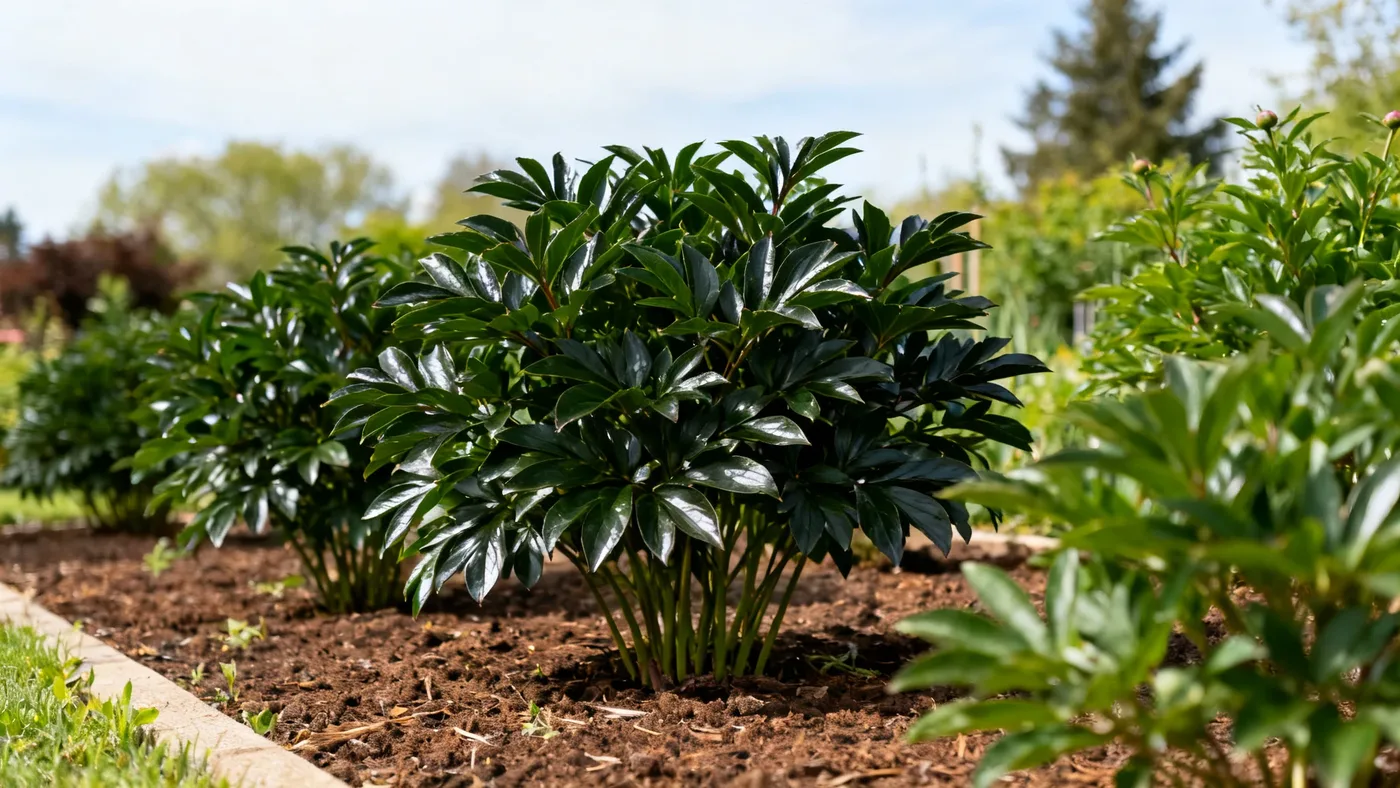
Fertilizing Kansas Peony: What, When and How Much to Use
Kansas Peony is a forgiving plant that thrives on minimal feeding once established. Unlike many perennials, this deep-rooted herbaceous peony does not demand heavy fertilization to produce its stunning deep red double blooms. In fact, overfeeding is one of the quickest ways to end up with tall, floppy stems and disappointing flowers. The right fertilizing strategy is light, well-timed, and focused on supporting structure and bloom formation, not vegetative growth.
Why Fertilize Kansas Peony at All?
Peonies planted in fertile, humus-rich, well-drained loam often need very little supplemental feeding. That said, annual nutrient replenishment makes sense in most home gardens. Soil depletes over time, organic matter breaks down, and the plant's root system is drawing nutrients year after year. A modest spring application supports robust shoot emergence, stronger stems, and reliable flowering each May.
Kansas Peony reaches its full flowering potential 3-4 years after planting. Once mature, the plant can persist and bloom for 50 or more years with minimal intervention. A light feeding schedule early in the season keeps that long-term performance on track without encouraging the lush, weak growth that leads to flopping.
Understanding Peony Fertilizer Needs: NPK Ratios Explained
When choosing a fertilizer for Kansas Peony, focus on the three numbers on the label: nitrogen (N), phosphorus (P), and potassium (K). Each plays a different role.
Nitrogen (N) drives leafy growth. Too much nitrogen and your peony shoots up tall and soft, producing more foliage than flowers. The stems flop under the weight of the blooms. For peonies, less nitrogen is better.
Phosphorus (P) and potassium (K) support flower and root development, along with overall plant hardiness. These are the nutrients you want to emphasize.
Look for a fertilizer with a ratio that is low in nitrogen compared to phosphorus and potassium. A balanced organic compost (roughly equal parts N-P-K) works fine. Alternatively, choose a formulation that leans toward phosphorus and potassium, such as a 5-10-10 or 0-10-10 ratio. Avoid anything high in nitrogen, such as 20-5-5 or lawn fertilizers formulated for grass growth.
Materials You'll Need
- One of the following: balanced organic compost, a low-nitrogen fertilizer blend (phosphorus/potassium-leaning), or a specialized peony fertilizer
- Measuring cup or small shovel for dispensing
- Gloves (optional, depending on fertilizer type)
- Watering can or garden hose for irrigation after application
- A ruler or measuring tape (optional, for gauging distance from the crown)
Quantity: For an established Kansas Peony plant (3-4 years old or mature), you will need roughly 1 cup to 2 cups of compost, or the amount specified on your granular fertilizer package for a single perennial planting.
Step-by-Step Instructions for Fertilizing Kansas Peony
Step 1: Identify the Right Timing
Fertilize Kansas Peony in early spring as shoots emerge from the ground. In zones 3-8, this typically means late March through April, depending on your local spring onset. Watch for the first red or bronze shoots breaking through the soil. Do not wait until the plant is fully leafed out. Early-season feeding supports shoot vigor from the start.
Step 2: Clear Debris Around the Base
Gently remove any mulch, dead leaves, or plant debris resting directly on the crown of the plant. If you cut back foliage in the fall (which is recommended to reduce overwintering disease spores), the growing point may still have some old stems. Clear these away so you have a clean view of where the shoots are emerging.
Step 3: Measure Out Your Fertilizer
For an established peony, a light application is key. Use roughly 1 to 2 cups of balanced organic compost, or follow the label rate for granular fertilizer formulated for perennials. If you are using a concentrated chemical fertilizer, less is more. Apply the smaller amount if this is your plant's first feeding or if the soil is already rich.
Step 4: Apply Around the Base, Not on the Crown
Scatter the fertilizer (or compost) in a circle around the base of the plant, starting about 3 to 4 inches away from the crown and extending outward to the drip line (the outer edge of the foliage canopy). Avoid piling material directly on top of the crown or the emerging shoots. This placement ensures nutrients reach the root zone while preventing rot or stem damage.
Step 5: Gently Work It Into the Soil Surface
If using compost, use your fingers or a small hand cultivator to lightly scratch it into the top inch of soil. For granular fertilizer, you can leave it on the surface, as water will carry the nutrients down. Do not dig aggressively around an established peony; the root system is shallow in some areas and you may damage it.
Step 6: Water Thoroughly
Water the area well after applying fertilizer. This activates granular products and ensures compost makes good soil contact. Water until the soil is moist to a depth of several inches. This step is essential for nutrient availability.
Step 7: Avoid Re-Applying Later in the Season
Resist the urge to fertilize again in summer or fall. A single light application in early spring is sufficient. Late-season nitrogen can encourage tender new growth that frost will damage, weakening the plant heading into winter.
Seasonal Fertilizing Schedule for Kansas Peony
Kansas Peony has simple seasonal needs. The bloom season (typically May in most zones 3-8) does not require feeding during or after flowering. The plant is drawing on stored reserves. Fall cleanup (cutting back foliage in late fall after frost) is housekeeping, not a feeding time. Here is the annual rhythm:
| Season | Action | Reasoning |
|---|---|---|
| Early Spring (late March-April) | Apply light fertilizer as shoots emerge | Supports robust stem and shoot development |
| Late Spring (May) | No fertilizer; blooming period | Plant draws on stored reserves; excess nitrogen reduces bloom quality |
| Summer (June-August) | No fertilizer; drought-tolerant established plants need minimal water | Heat and reduced water slow growth; feeding is wasted |
| Fall (September-November) | No fertilizer; cut back foliage after frost | Plant moves resources underground for winter dormancy |
| Winter (December-February) | No action | Plant is dormant; roots are not active |
Tips for Best Results
- Match fertilizer to soil type. If your soil is already amended with compost or is known to be fertile, use a lower rate or skip the first year and reassess. If soil is sandy or depleted, lean toward the higher rate (1.5 to 2 cups of compost).
- Test soil pH if blooming is poor. Kansas Peony prefers slightly acidic to neutral soil (pH 6.5-7.0). If your garden's pH is off, nutrient availability suffers. A simple soil test kit from a local cooperative extension will tell you if pH is the culprit.
- Use organic compost as a baseline. If you are uncertain about ratios and formulations, balanced organic compost (purchased or homemade) is a safe, slow-release option that enriches the soil structure at the same time it feeds the plant. It is nearly impossible to overdo it with compost.
- Do not fertilize newly planted peonies heavily. If you planted a division or container-grown peony last fall or earlier this spring, hold off on heavy feeding for the first year. A light application of compost is fine; the transplant energy should be going to root establishment, not shoot growth.
- Combine spring fertilizer with good sunlight. Kansas Peony needs full sun (6 or more hours per day) to produce strong stems and reliable flowers. No fertilizer can compensate for inadequate light. If your plant is in shade or partial shade, consider relocating it or adjusting your expectations for bloom count.
Common Mistakes to Avoid
Mistake 1: Using high-nitrogen lawn fertilizer. Lawn fertilizers are formulated to encourage leafy growth in grass. Applied to peonies, they produce tall, floppy stems that need staking and fewer blooms. Stick to perennial-focused or phosphorus/potassium-leaning formulas.
Mistake 2: Applying fertilizer directly on the crown. The crown (where shoots emerge) can rot if buried under fertilizer and kept wet. Always apply 3 to 4 inches away from the center of the plant.
Mistake 3: Fertilizing multiple times per season. Peonies do not need summer or fall feeding. A single light application in early spring is the rule. Multiple feedings can weaken winter hardiness and encourage disease.
Mistake 4: Assuming lack of blooms is a fertilizer problem. Peonies that produce few or no flowers are usually responding to too much shade, planting too deep, or being too young (first 2-3 years after planting often yield sparse flowers). Before fertilizing, verify that your peony gets sufficient sunlight and that the crown sits no more than 1 to 2 inches below the soil surface.
Mistake 5: Overwatering after fertilizer application. While a good watering after fertilizing is essential, daily watering after that is not. Established Kansas Peony is moderately drought tolerant once rooted. Overwatering promotes root rot and attracts pests. Water during dry spells, but trust the plant's resilience in normal conditions.
What to Expect After Fertilizing
With consistent light spring feeding, Kansas Peony shows measurable improvements over 2 to 3 seasons. Shoot emergence in spring may be slightly earlier or more vigorous. Stems may stand a touch taller and thicker, with better capacity to support the dense double blooms without staking (though large-flowered peonies in windy locations may still benefit from light support). Foliage may appear a richer green during the growing season.
Do not expect dramatic changes in a single season. Peonies are slow, deliberate plants. The real payoff is consistency. A well-fed peony planted in the right location and soil will reliably produce flowers year after year, with minimal fuss. For more complete care guidance, see the Kansas Peony care guide.
Quick Reference: Kansas Peony Fertilizing Checklist
| Item | Recommendation |
|---|---|
| Best Timing | Early spring as shoots emerge (late March to April) |
| Fertilizer Type | Low-nitrogen, phosphorus/potassium-leaning formula or balanced organic compost |
| NPK Ratio Example | 5-10-10, 0-10-10, or balanced compost |
| Amount Per Plant | 1 to 2 cups of compost or per-label rate for granular fertilizer |
| Application Distance | 3 to 4 inches from the crown, out to the drip line |
| Frequency | Once per year in early spring only |
| After Application | Water thoroughly; no re-feeding in summer or fall |
| Soil pH Target | 6.5-7.0 (slightly acidic to neutral) |
| Avoid | High-nitrogen formulas, crown burial, multiple-season applications |
| Zones | 3-8 (timing may shift by 2-4 weeks by region) |