What Does a Kansas Peony Look Like? Bud, Bloom and Foliage
A Kansas peony tag promises a red double. The garden-center photo promises the same, usually under flattering light. The surprising part is that even the color is disputed: Kansas is called red, yet it is also called rose pink. So how much can you verify from across a yard?
Less than the tag implies, and more than you might fear, if you know which clues carry weight and which are shared by nearly every peony.
This guide covers everything you need to know about what Kansas looks like, from the size of the clump in winter and summer to the shoots, buds, open blooms and the petal detail that settles identification. We weigh each clue and tell you how much it proves.
Spotting a Kansas Peony Across the Whole Garden
From a distance, you can judge shape, size and season. You cannot judge cultivar. That is the honest limit of a yard-length glance, and it is still useful, because it rules out a few impostors before you ever walk over.
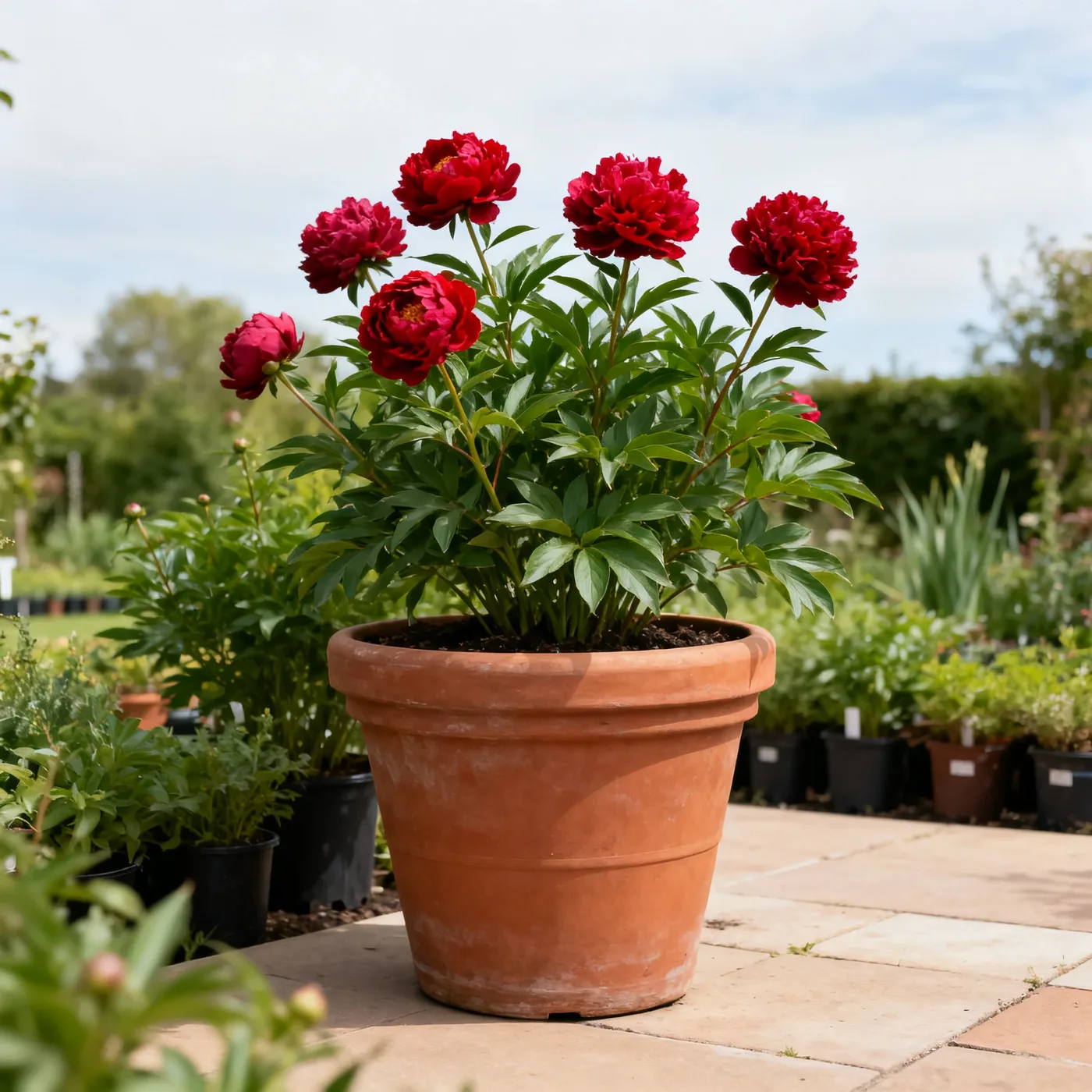
Kansas is a clump-forming herbaceous perennial reaching about 31 inches, with both height and spread listed at roughly 20 to 39 inches. Expect an upright, rounded bush rather than a sprawler. A plant that flops open into a wide skirt or towers well past a yard is probably something else, or Kansas in unusually rich soil. Our full numbers are in the Kansas peony size guide.
Young plants will look smaller than any of that. Kansas takes 2 to 5 years to reach maturity, so a three-year-old clump with a handful of stems is normal, not a sign of the wrong plant. Peonies reward patience, and a small clump in year two is simply a crown still building.
What the Clump Does Across the Year
Herbaceous peonies die back completely during the winter. A dormant Kansas is bare ground, perhaps a few short stubs if you cut late. Anyone claiming to identify a peony from a leafless bed is guessing, and a marker stake or a photo from last June is worth more than a squint at the soil.
Then the plant builds through spring, flowers in late spring to early summer, and holds its leaves through summer. In fall the foliage can turn brown, copper, orange or burgundy before it collapses, which means the clump looks different in October than it did in July. That change is normal, not a sign of trouble.
Through all of it the plant keeps one habit: it comes back in the same spot, a little larger, for decades. That fixed, returning position is the one thing a mystery plant in an old bed has going for it.
Verdict: habit and season fit, which rules out a few impostors, but they prove nothing alone.
The Mound of Glossy Foliage Up Close
Step closer and the clump becomes a mound of deeply divided leaves. Kansas has dark green, divided foliage, and peony leaves are glossy and divided, with leaflets 3 to 8 inches long.
Here is the skeptic's point. Gloss and dark green are peony traits, not Kansas traits. A healthy lactiflora of almost any name looks like this in June. Foliage tells you that you have a peony and that it is in good shape.
Health matters, though, because the leaves are the plant's report card. Powdery mildew can affect many cultivars, and it dulls that gloss with a gray-white film late in the season. Dull leaves in August are a disease signal, not an identity clue.
How the Mound Holds Together
What you can read in the mound is structure. Stems should stay upright, leaves should be dense enough to hide the ground beneath, and the outline should be rounded. That fits the upright bush we describe for Kansas, but again, not uniquely.
Look at the leaf itself rather than the whole mound. Each leaf splits into several leaflets with smooth edges, oval to pointed, and the surface should have a sheen in good light. Older leaves on the same plant can look a shade duller than new growth, and that is ordinary aging.
Size gives one more hint. If the mound is much shorter than the roughly 20 to 39 inches listed, even after several years, think about light and soil before you think about identity. Our bloom time guide also shows how a crowded or shaded clump runs late and thin.
Do Red Shoots Prove a Kansas Peony?
No. This claim gets repeated more than any other, and it does not hold up.
Penn State Extension notes that new peony shoots look quite red, almost like rhubarb, and that they lose that red coloration as they begin to leaf out. The source describes peonies in general. Red shoots are the normal start for the whole group.
So a red-tipped shoot in early spring fits Kansas, and it fits every other herbaceous peony in the neighborhood. A pink-flowered peony and a white one will push the same rhubarb-colored spears.
What shoots can tell you is condition. Thick, firm, richly colored shoots mean a crown with good reserves. Thin, pale or distorted shoots point to a weak or struggling plant, not a different cultivar.
There is also a timing clue, though a soft one. Shoots emerge early, and the red shifts to green within a short stretch as leaves expand. If you want a record, photograph the shoots on the day they emerge, because a week later the color will already be fading.
Verdict: treat red shoots as proof of peony, never as proof of Kansas.
Round Buds and What They Reveal
Buds are the first stage with real information. Penn State notes large flower buds form by May in its region, and your timing will shift with climate. Buds begin as small, hard knobs at the stem tips and swell for weeks before they show any color.
Catalog copy loves the phrase "round buds." Round, firm buds are what a double peony produces before opening, so roundness describes the type, not the cultivar. We would not call it a Kansas clue, and we would not pay extra for a plant because the photo shows one.
Color is better. A Kansas bud that cracks open should show red at the seam, not pale pink or white. If the opening bud is blush, you are probably not looking at the registry description of bright red.
Ants crawling over the buds are normal. They visit for the nectar the buds secrete, and they do not harm the flower or affect identification. Do not spray them off in a panic.
- A tight, round bud with red showing at the seam is consistent with Kansas.
- A pale bud that opens to a flat or single flower is not.
- Buds that never open on a young plant are a vigor question, not an identity one, and our buying guide explains what a healthy starting crown looks like.
Full Double Blooms on a True Kansas Peony
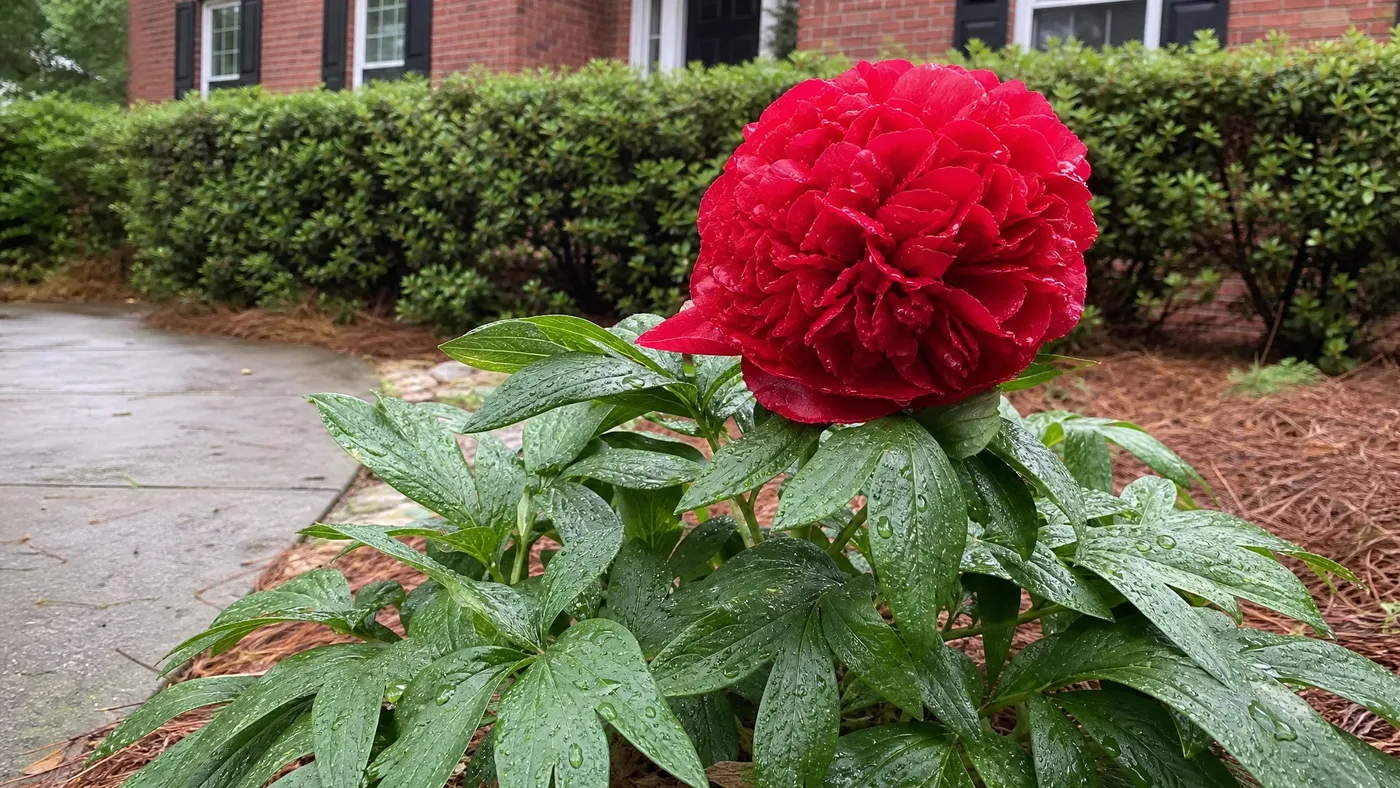
The open flower is where identification gets serious. The sources agree on one thing: Kansas is double. The flower is fully double, a bright clear red containing almost no blue, fading very little if at all.
Color is less settled, since Kansas is also called rose pink. We side with red, and Kansas should read as a bright, clear red with almost no blue in it, not a candy pink. Photographs and screens push it either direction, so see our color guide before judging by a phone picture.
Each plant blooms for about two weeks. Plan to check the flower in that window, not a week later when sun and rain have worn the petals.
Checking the Catalog Against the Bloom
Use these as a checklist when the first flower opens:
- The flower should be full and dense, with petals packed to the center.
- The color should read red, not lavender-pink and not white-blushed.
- The edges should be ruffled rather than smooth and flat.
- The color should hold as the flower ages, rather than washing out within days.
One of the most common questions we get is whether a blooming plant that looks a little pink is wrong. Usually it is light, a cool morning, or a half-open flower. Wait for the full flower.
Heavy double blooms are also the reason for a practical note. The flower head is large and full, and wet weather can bow the stems. A bent stem after rain says nothing about identity, only about weight.
Petal Detail That Settles the Doubt
Get close to a fully open bloom and look at the center. In a fully double flower, petals fill the middle, and few if any stamens show. Single and semi-double peonies display a visible tuft of yellow stamens. Seeing one in your supposed Kansas is a mark against it.
Petal count is where catalogs get slippery. No source we trust gives a verified number for Kansas, so we do not either. Be wary of anyone quoting an exact count, and trust the visible fullness over a figure.
Next, look at petal color in shade, not noon sun. "Almost no blue" means the red should not drift toward purple. A magenta cast on red is fine, but a plum or lilac cast suggests another cultivar.
Finally, watch the fade. Kansas fades very little. A flower that bleaches visibly in two days of sun is a poor match.
Fragrance is a tempting extra clue, but scent varies with heat and time of day, and it differs from nose to nose. Our fragrance guide covers what to expect, and we would not use it to settle a doubt.
Confirming the Kansas Peony You Received
Now pull the clues together. The table sorts them by how much each one proves.
| Clue | What to expect | How much it proves |
|---|---|---|
| Red spring shoots | Rhubarb red, fading as leaves open | Almost nothing, it is shared |
| Glossy dark foliage | Divided, dark green leaves | Little, it is peony-wide |
| Round buds | Large, firm, red at the seam | Some, mostly on color |
| Open flower form | Fully double, dense, ruffled | A lot |
| Color and fade | Bright red, holds well | The most |
Our advice is to ignore the first two and judge by the last two. A related trap is confusing Kansas with other reds, especially Karl Rosenfield, which we compare in how to tell them apart.
Be patient with new plants. A first-year plant may flower thinly or not at all, and early blooms can look simpler than mature ones. We often see customers decide a plant is wrong in year one that turns out fine in year three.
If you bought from us, keep the tag and photograph the first full flower beside it. Write down the date, the weather and the light, so that next year's flowers have something to be compared with.
Let the Flower Settle Your Kansas Peony Question
Shoots, foliage and buds tell you that you have a healthy peony. The open flower tells you which one. Fully double, red, dense and slow to fade is Kansas, and anything much paler or flatter deserves a second look.
Wait for one full bloom season before deciding, and trust the flower over the label.
Kansas Peony
Nursery-grown Kansas Peony in sizes from #2, shipped to your door.
From $74.60
Shop Now →Kansas does its best work for us in full sun, planted in deep, fertile ground that drains well, which is where that dense red flower comes into its own. Our team of growers tends every plant on farms we own, and we keep to top-quality plants and nothing less. If you want that deep red bloom opening in your own beds, choose a Kansas from our nursery.